Software Development: A Comprehensive Overview
- By: Hammad ur Rahman CO-Founder & CTO
- Category: mobile app development services|web design & development
- Date: January 8, 2024

Software development is an essential pillar of technological advancement, serving as a main player for innovation and transforming the way in which we connect with the world. Now, let’s explore the core of software development and uncover its utmost significance.
Introduction to Software Development
Software development is a disciplined approach to creating, designing, testing, documenting, and maintaining computer programs. In our fast changing technological world, software holds great importance in developing and maintaining our digital experiences.This introduction provides a gateway into the unexpected reality of software development, by deeply researching its significance, evolution, and the unique principles that boosts innovation in this field.
Evolution of Software Development
The field of software development has undergone a remarkable evolution, spanning several decades and characterised by transformative shifts and innovations. Let’s explore a historical journey through the key stages that have shaped the field into its current form.
- Early Foundations of Computation (1940s-1950s) During this period, the foundations of computation were laid on researchers exploring the potential of electronic machines to solve complex mathematical problems.
- Assembly Language and Punch Cards (1950s-1960s) As computers became more accessible, assembly language and punch cards were introduced to enable developers to write instructions directly for the computer hardware.
- High-Level Languages and Compilers (1950s-1960s) The advent of high-level languages like FORTRAN and COBOL revolutionised software development, allowing programmers to write code in human readable format.
- Software Crisis and Structured Programming (1960s-1970s) With the rapid growth of software complexity, they realised that traditional approaches were not enough.
- Object-Oriented Programming (1970s-1980s) Object-oriented programming brought a new framework that focused on modelling software systems using objects with their own data and behaviour.
- Open Source Movement and the Internet Age (1980s-1990s) The open-source movement gained momentum during this period, with developers freely sharing source code and collaborating on projects. The rise of the internet boosts connectivity and enables global collaboration.
- Agile Manifesto and Iterative Development (2001) Recognizing the need for more flexible development methodologies, the Agile Manifesto was created. It emphasized iterative development, customer collaboration, adaptability, and quick response to change.
- DevOps & Continuous Integration (2000s-2010s) The DevOps culture emerged, promoting collaboration between development and operations teams to streamline software delivery. Continuous integration allowed for frequent code integration and automated testing.
- Cloud Computing and Microservices Architecture (2010s) The advent of cloud computing revolutionised the way applications are developed, deployed, and scaled. Microservices architecture gained popularity, enabling developers to build modular, scalable systems.
- Artificial Intelligence and Machine Learning (2010s) – AI and machine learning became more common in making computer programs. These smart systems can learn from data and make choices or guesses.
- Blockchain and DApps (2010s) The use of blockchain tech has changed how things work by letting new decentralized apps run. These let you see what’s happening, keep things safe without issues and control contracts by themselves.
- Future Trends & Quantum Computing (2020s and Further) Looking forward, quantum computing has potential to deal with hard tasks on a never-before level. As technology continues to advance rapidly in this new decade, we anticipate further groundbreaking innovations that will shape the future of software development.
Software Development Life Cycle
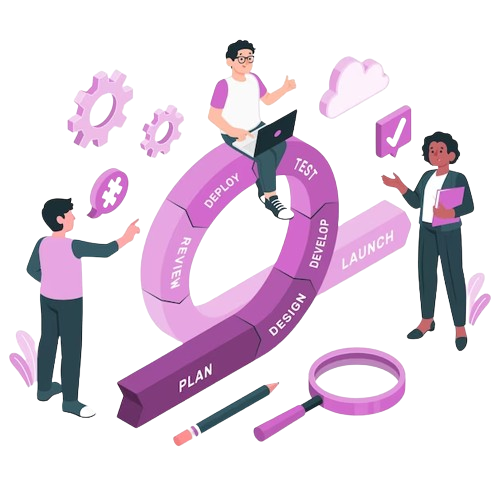
The Software Development Life Cycle (SDLC) is a good organized process that helps make computer programs. It gives directions on how to do it right. It’s like a guide, marking the key steps and stages of making, trying out, putting into use and looking after software. SDLC is a properly settled process that helps to guide development of main software apps. It is alike a scheduled roadmap that enhances or highlights major points and phases of generating, examining, locating and maintaining software.
Planning phase: In the planning stage of a project, we decide on what we want to achieve and check if it can be done. A full study is done to check the technical parts of the project, such as hardware, software and people involved.
Design phase: When the planning part is done, it’s time to start on the design part. This is when the system and software making plans are done. It says how to make the computer program, what it will do and its features. Now that we have the design requirements ready, it’s time for doing or writing code. During this process, developers write the code for software by following the plans they’ve made.
Testing Phase: Checking is very important and necessary in making sure that software works the way it’s supposed to. The testing part has different kinds of tests like unit, integration, system and user acceptance tests. These tests find any mistakes or problems that must be seen before putting them into use.
Deployment Phase: During deployment, software is lived either to a limited resource or to the public. Deployment can be done in different stages or all at once. Feedback from users or resources is collected during this stage to improve and correct the software.
Maintenance phase: Once deployment is done, software shifts to its maintenance phase. During this phase, any issues that occur are corrected by fixing errors or bugs and improving new features based on user feedback. This live support ensures that users get exceptional experience with their chosen software solution.
Overview of SDLC Phases
The Software Development Life Cycle (SDLC) is an essential element of Quality Assurance (QA), providing an aligned framework for the whole software development procedure. SDLC ensures system development, starting with planning and detailed studies that establish a well organised development journey. This structured approach allows for timely detection of defects through multiple testing phases, reducing the spread of issues and overall development costs.
One of the key benefits of SDLC is effective communication among team members and stakeholders, shared understanding of project goals and quality requirements. Additionally, SDLC incorporates risk management strategies to identify and address potential risks early on. This approach contributes to overall project quality and success. The consistency offered by SDLC enables the application of successful practices and lessons learned from previous projects.
Ultimately, SDLC plays a critical role in achieving customer satisfaction by delivering a product that meets expectations. It also assists particularly in industries with requirements, ensuring standards and regulations. In essence, SDLC in QA is essential for achieving high-quality software by encompassing efficiency, risk reduction, and regulatory alignment.
Development Methodologies

In the complex world of software development, the choice of methodologies plays a critical role in shaping the project lifecycle. Let’s explore different development methodologies, each presenting a unique approach to achieving success in coding.
Waterfall Model: This method follows a sequential and linear progression through distinct phases. It places emphasis on entire documentation and planning.
Agile Methodology: With a collaborative approach, Agile gives priority to flexibility, adaptability, and continuous customer feedback. It allows for continuous improvements throughout the development process.
Scrum Framework: Built upon Agile principles, Scrum focuses on impressive progress. It utilises daily stand-ups, and continuous communication to boost more efficient teamwork. Kanban Method: Improving transparency by enhancing workflow, Kanban ensures a fast and aligned flow of work items. This method encourages effective collaboration among team members and different resources.
Extreme Programming (XP): XP is an Agile methodology that places strong emphasis on producing high-quality code. Through practices like pair programming, continuous integration, and frequent releases.
DevOps Practices: By setting up development and operations, DevOps starts collaboration across teams. Continuous integration, continuous delivery, and automation are essential components of this method.
Feature-Driven Development (FDD): FDD takes a model driven and impressive approach to software development. It centres around feature development with regular blocks as its key focus areas.
Rapid Application Development (RAD): This method emphasises quick development through iterative prototyping. RAD incorporates user feedback at every stage of the process to ensure customer satisfaction.
Lean Software Development: Derived from lean manufacturing principles, Lean Software Development aims to minimise waste while maximising value. It focuses on efficiency and delivering quality results to customers.
Spiral Model: Combining elements of both waterfall and prototype models in an iterative cycle, Spiral Model emphasises risk analysis and mitigation at each iteration.
Incremental Model: In this model, the system is designed, implemented, and tested incrementally. Each increment adds new functionality to the existing system, allowing for ongoing enhancements.
V-Model (Verification and Validation Model): Parallel development of testing and coding phases characterises this model. Every phase has a corresponding testing phase to ensure comprehensive verification and validation.
By understanding these various methodologies, software development teams can choose the approach that best suits their project requirements. Mastering these methods is crucial for achieving success in today’s dynamic landscape of coding and creation.
The Role of AI and Automation
In software development, AI and Automation are catalysts for innovation and efficiency. From automated testing to intelligent code generation, analytics, and personalised user experiences, their impact is impressive and transformative. They aligned processes, enhanced decision making, stepping in a new era of intelligent systems. As AI and Automation continue their evolution, their integration into software development defines a shift. Adapting to and leveraging these technologies is not just a strategic choice but an essential step toward navigating the ever-evolving landscape of modern software development.
BACK


 USA
USA
 CANADA
 AUSTRALIA
 PAKISTAN
